Top Trumps: Global Fixed Income – 15 October 2026
This week, FSA compares the T. Rowe Price Global Government Bond fund and the Amundi Global Government Bond fund.

This week, FSA compares the T. Rowe Price Global Government Bond fund and the Amundi Global Government Bond fund.
This week, FSA compares the T. Rowe Price Global Government Bond fund and the Amundi Global Government Bond fund.

The launch comes two weeks after launching an optical communication ETF.

Asian estate investment trusts (REITs) lack the exposure to high-growth sectors that has helped their US counterparts withstand rising interest rates, according to Jen-Ai Chua.
Asian estate investment trusts (REITs) lack the exposure to high-growth sectors that has helped their US counterparts withstand rising interest rates, according to Jen-Ai Chua.

Small and mid-market buyouts, asset-based finance and infrastructure debt are key areas to help investors navigate an uneven recovery in private markets, according to Nils Rode, Schroders Capital’s chief investment officer.

Sponsored by Loomis Sayles & Natixis
The Growth Equity Strategies Team at Loomis Sayles, an affiliate of Natixis Investment Managers, demonstrates that patience, discipline and conviction result in consistent, peer-leading risk-adjusted compounding over cycles.
Asian estate investment trusts (REITs) lack the exposure to high-growth sectors that has helped their US counterparts withstand rising interest rates, according to Jen-Ai Chua.
Small and mid-market buyouts, asset-based finance and infrastructure debt are key areas to help investors navigate an uneven recovery in private markets, according to Nils Rode, Schroders Capital’s chief investment officer.
Asian estate investment trusts (REITs) lack the exposure to high-growth sectors that has helped their US counterparts withstand rising interest rates, according to Jen-Ai Chua.
Asian estate investment trusts (REITs) lack the exposure to high-growth sectors that has helped their US counterparts withstand rising interest rates, according to Jen-Ai Chua.

Expresses preference for shorter-term or inflation-linked bonds.
This week, FSA compares the T. Rowe Price Global Government Bond fund and the Amundi Global Government Bond fund.
This week, FSA compares the T. Rowe Price Global Government Bond fund and the Amundi Global Government Bond fund.

This week FSA compares two European equities funds: BlackRock GF European Value fund and the JPMorgan Europe Dynamic fund.
The launch comes two weeks after launching an optical communication ETF.
The launch comes two weeks after launching an optical communication ETF.

The shift towards higher interest rates is creating opportunities for selective exposure to financial stocks, says Min Zeng.
This week, FSA compares the T. Rowe Price Global Government Bond fund and the Amundi Global Government Bond fund.

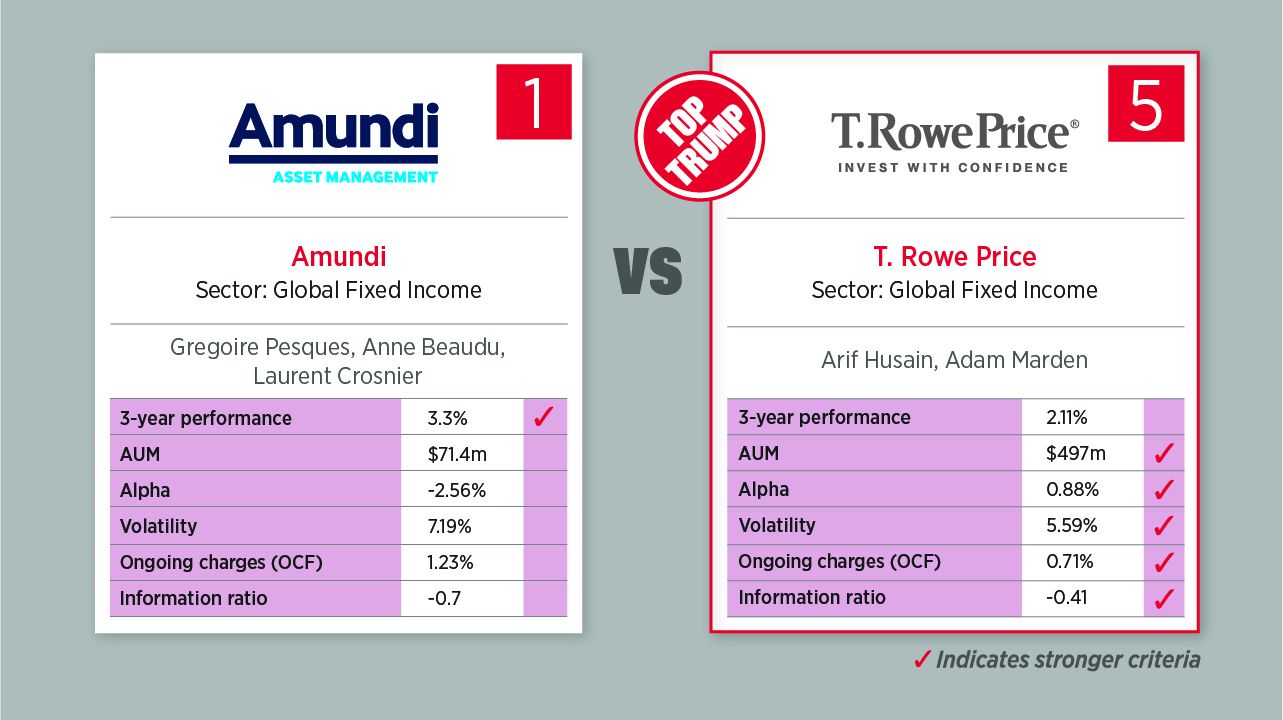
Based on the popular 80s card game, each week we select an asset class and use FE fundinfo data to compare two funds based on their three-year performance, assets under management, alpha, volatility, ongoing charges and information ratio to decide which is the Top Trump.
This week, T. Rowe Price Global Government Bond defeats Amundi Global Government Bond: 5-1.
The fund invests in an actively managed, concentrated global bond portfolio of high-conviction, high-quality government bonds from liquid sovereign markets, with limited exposure to emerging market risk.
Top 10 issuers:
JAPAN (19.92%)
U.S. TREASURIES (18.27%)
JPMORGAN CHASE (13.68%)
FRENCH REPUBLIC (10.97%)
REPUBLIC OF ITALY (10.34%)
UNITED KINGDOM OF GREAT BRITAIN AND NORTHERN IRELAND (9.20%)
REPUBLIC OF SINGAPORE (6.57%)
REPUBLIC OF IRELAND (1.48%)
KINGDOM OF BELGIUM (1.28%)
KINGDOM OF THE NETHERLANDS (0.74%)
The fund aims for a combination of income and capital growth (total return), and invests at least 67% of assets in investment-grade bonds that are either issued or guaranteed by OECD governments or supranational entities (at least 60% of assets), or issued by corporate entities.
Top 10 issuers:
UNITED KINGDOM (16.65%)
FEDERAL REPUBLIC OF GERMANY (11.13%)
SPAIN (KINGDOM OF) (7.57%)
UNITED STATES OF AMERICA (5.46%)
NEW ZEALAND (4.98%)
BRAZIL (4.98%)
ITALIAN REPUBLIC (4.83%)
CZECH REPUBLIC (4.33%)
JAPAN (3.48%)
AUSTRALIA (COMMONWEALTH OF) (3.24%)
*All relevant fund data converted to US dollars for comparative purposes. Performance, alpha and volatility are annualised over three years with data as reported at the end of last month. Information ratio (IR) aims to measure a portfolio manager’s consistent ability to generate excess returns relative to a benchmark. The higher the IR, the more consistent the manager is.

Rising bond yields are putting pressure on lower-quality credit and narrowing stock market leadership, although resilient earnings could continue to support US equities, says Brian Levitt.
Small and mid-market buyouts, asset-based finance and infrastructure debt are key areas to help investors navigate an uneven recovery in private markets, according to Nils Rode, Schroders Capital’s chief investment officer.

Also intends to enhance sustainability reporting at entity and fund level.