T. Rowe Price’s Mallet: I’ve had to rotate my portfolio after the best year of my career
The manager of the $1.5bn T. Rowe Price Global Value Equity fund tells FSA where he sees the next opportunity.


The manager of the $1.5bn T. Rowe Price Global Value Equity fund tells FSA where he sees the next opportunity.
The manager of the $1.5bn T. Rowe Price Global Value Equity fund tells FSA where he sees the next opportunity.

Angela Jin joins the asset manager from Capital Group.
The manager of the $1.5bn T. Rowe Price Global Value Equity fund tells FSA where he sees the next opportunity.
The manager of the $1.5bn T. Rowe Price Global Value Equity fund tells FSA where he sees the next opportunity.

The final €6bn close was reached six months after the first close.
Sponsored by Loomis Sayles & Natixis
The Growth Equity Strategies Team at Loomis Sayles, an affiliate of Natixis Investment Managers, demonstrates that patience, discipline and conviction result in consistent, peer-leading risk-adjusted compounding over cycles.
The manager of the $1.5bn T. Rowe Price Global Value Equity fund tells FSA where he sees the next opportunity.
The final €6bn close was reached six months after the first close.
The manager of the $1.5bn T. Rowe Price Global Value Equity fund tells FSA where he sees the next opportunity.
The manager of the $1.5bn T. Rowe Price Global Value Equity fund tells FSA where he sees the next opportunity.

The bank says yields are an attractive opportunity to lock in yields and has downgraded its view on equities to neutral.

The founders’ wish to retain control remains a barrier to intergenerational succession, a DBS commissioned report found.
The founders’ wish to retain control remains a barrier to intergenerational succession, a DBS commissioned report found.

A Morningstar report says the recent volatility in the bond market has created “one of the most compelling opportunities in years”.
The bank says yields are an attractive opportunity to lock in yields and has downgraded its view on equities to neutral.
The bank says yields are an attractive opportunity to lock in yields and has downgraded its view on equities to neutral.
The founders’ wish to retain control remains a barrier to intergenerational succession, a DBS commissioned report found.
The manager of the $1.5bn T. Rowe Price Global Value Equity fund tells FSA where he sees the next opportunity.

After rotating out of high-flying memory stocks before a correction, Sebastien Mallet, portfolio manager at T. Rowe Price, sees gold royalty companies as the next opportunity.
18 months ago, Mallet went overweight memory and central processing unit (CPU) stocks which he described as “left for dead and very cheap”.
This was before the sector re-rated following blockbuster earnings on the back of a historic artificial intelligence (AI) driven shortage.
This move has helped the $1.5bn T. Rowe Price Global Value Equity fund that Mallet manages to deliver top-decile performance against its global peers over the past twelve months, according to data from FE fundinfo.
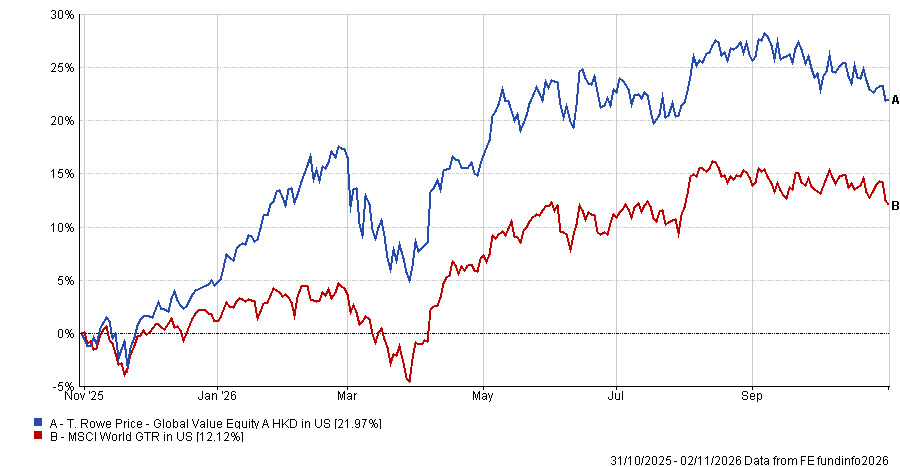
“I’m having the best year of my career, so I had to rotate my portfolio because I’m focused on risk-reward,” Mallet told FSA in an interview.
“When a stock performs a lot, then the risk-reward looks negative to the downside, so I’ve sold quite a lot of cyclical tech,” he said, referring to memory and CPU.
As such, he has since gone from holding four memory stocks to just one, Micron, which is in the fund’s top-10, and some CPU names, because he believes that there is still a shortage of compute.
Instead, the next opportunity that Mallet views as compelling is in gold royalty companies, which he prefers over gold miners.
The price of gold has fallen over 25% from $5400 per ounce at the peak to trading just below $4000 an ounce today, a level below which Mallet says he is ready to add.
“Gold royalty companies are more expensive, but they are long duration assets, and you don’t take single mine risks, and they give you a dividend that goes up with the price of gold,” he said.
“Gold is roughly $4000 right now, but these stocks price a lot less because the market is sceptical that this gold value can be sustained.”
While he does not have a short-term prediction for the price of gold, Mallet believes that gold could reach $10,000 an ounce by the end of the decade.
He views gold as a currency-like asset that protects against currency debasement, supported by limited mine-supply growth of roughly 1–2% per year, and increased demand from Chinese consumers and its central bank.
Indeed, the People’s Bank of China has been adding to its gold reserves for 23 consecutive months, according to its officially reported data.
“I’m a big believer in gold,” Mallet said. “It has been called a barbarian relic, but if you go back to ancient Rome, a centurion was paid about 39 ounces of gold. Today a captain in the US army is paid about 39 ounces of gold. The same job, 2000 years apart, the same price in gold.”
“The bottom line is, gold preserves purchasing power, and I believe we are in an era of fiscal dominance, as we have massive deficits from governments in the West to finance social spending, defence, decarbonisation, decarbonisation. That’s well known.”
“What is less well known is how do we finance that? Over time, we finance that by printing money, [which leads to] a debasement of currency.”
In Mallet’s view, the correlation between interest rates and gold has broken down, and that “higher rates for longer” does not necessarily weigh down the fundamentals of the precious metal.
He believes that the “collision of government borrowing and private borrowing” means that lower rates are very unlikely in the future, and that high rates are “oxygen” to the financial sector.
“It’s fantastic for banks. It’s great for insurance, and that’s a large part of the value index,” he said. “So that helps us a lot.” The fund has roughly 20% of its portfolio allocated to the financial sector.
ChinaAMC (HK) makes AI ETF and Value Partners makes US dividend ETF available to Mainland China investors.

Here is a digest of significant wealth and asset management appointments, promotions and departures during the previous month.

Florian Neto has joined the firm to lead its investment teams in Asia Pacific.