BlackRock versus MFS Meridian: Head-to-Head
This week FSA compares the BlackRock Global Funds – Emerging Markets fund and the MFS Meridian Funds – Emerging Markets Equity fund.


This week FSA compares the BlackRock Global Funds – Emerging Markets fund and the MFS Meridian Funds – Emerging Markets Equity fund.
This week FSA compares the BlackRock Global Funds – Emerging Markets fund and the MFS Meridian Funds – Emerging Markets Equity fund.

Asian investment grade credit is better prepared for the energy fallout than in previous years, according to Nomura Asset Management’s head of fixed income, Simon Tan.

The acquisition should expand the asset manager’s European private markets capabilities.
The acquisition should expand the asset manager’s European private markets capabilities.

Pictet has announced the final close of its oversubscribed Monte Rosa Co-Investments VI private equity fund.

Sponsored by Loomis Sayles & Natixis
The Growth Equity Strategies Team at Loomis Sayles, an affiliate of Natixis Investment Managers, demonstrates that patience, discipline and conviction result in consistent, peer-leading risk-adjusted compounding over cycles.
This week FSA compares the BlackRock Global Funds – Emerging Markets fund and the MFS Meridian Funds – Emerging Markets Equity fund.
The acquisition should expand the asset manager’s European private markets capabilities.
Asian investment grade credit is better prepared for the energy fallout than in previous years, according to Nomura Asset Management’s head of fixed income, Simon Tan.
Asian investment grade credit is better prepared for the energy fallout than in previous years, according to Nomura Asset Management’s head of fixed income, Simon Tan.

There are fundamental reasons for the parabolic rally, according to Man Group’s Nick Wilcox.
This week FSA compares the BlackRock Global Funds – Emerging Markets fund and the MFS Meridian Funds – Emerging Markets Equity fund.
This week FSA compares the BlackRock Global Funds – Emerging Markets fund and the MFS Meridian Funds – Emerging Markets Equity fund.

FSA looks at the top performing funds 100 days after the outbreak of the Iran war on February 28th.
Asian investment grade credit is better prepared for the energy fallout than in previous years, according to Nomura Asset Management’s head of fixed income, Simon Tan.
Asian investment grade credit is better prepared for the energy fallout than in previous years, according to Nomura Asset Management’s head of fixed income, Simon Tan.

The service provides family offices and wealthy individuals access to institutional-grade products and services.
This week FSA compares the BlackRock Global Funds – Emerging Markets fund and the MFS Meridian Funds – Emerging Markets Equity fund.

Emerging market (EM) equities have maintained their outperformance from 2025 into this year, driven by investors diversifying away from US dollar-denominated assets and supported by stronger corporate earnings and reasonable valuations. Of course, the AI boom has played a significant part, with South Korean and Taiwanese technology companies intrinsic to the sector.
Since the beginning of 2024, the MSCI Emerging Markets Index has returned 72.55% compared with 60.28% by the S&P 500 and 56.94% by the MSCI World Index, according to FE fundinfo. The EM index is up 18.86% year-to-date (8 June 2026), more than double the S&P 500 (8.76%) and MSCI World Index (8.28%).

The macroeconomic conditions have also improved in several EM countries, as evidenced by lower debt-to-GDP ratios, greater confidence in central banks, and corporate governance initiatives. Nevertheless, volatility is likely as economies struggle with the effects of higher oil prices and inflation.
FSA asked Stephanie Ting, associate manager, research analyst at Morningstar to compare two emerging market equity strategies. She chose the BlackRock Global Funds – Emerging Markets fund and the MFS Meridian Funds – Emerging Markets Equity fund.
| BlackRock | MFS | |
| Size | $816m | $49m |
| Inception | 1993 | 2006 |
| Managers | Gordon Fraser, Kevin Jia | Jose Luis Garcia, Harry Purcell, Rajesh Nair |
| Three-year cumulative return | 54.19% | 68.67% |
| Three-year annualised return | 16.29% | 19.37% |
| Three-year annualised alpha | -5.36% | 1.81% |
| Three-year annualised volatility | 17.70% | 19.07% |
| Three-year information ratio | -0.58 | -0.04 |
| FE Crown fund rating | * | *** |
| Morningstar medal | Neutral | Neutral |
| OCF | 1.87% | 2.00% |
The MFS strategy follows a bottom-up, fundamentally driven investment process focused on reasonably priced stocks with strong free cash flow and returns on invested capital, while avoiding businesses with excessive leverage, according to Ting.
This results in a portfolio with a quality bias, reflected in consistently higher returns on assets, equity and invested capital, as well as lower debt-to-capital ratios than the MSCI Emerging Markets Index.
“It also translates into relatively stable portfolio positioning, including long-term overweight in more debt-light, cash-generating sectors such as consumer staples, and underweight in more cyclical or capital-intensive sectors such as materials,” Ting said.
The portfolio typically holds 70-100 names. Risk is more tightly controlled, with country and sector exposures limited to +/-4% and +/-6% relative to the MSCI Emerging Markets Index, respectively.
Conversely, the BlackRock strategy follows a flexible approach that combines bottom-up and top-down research.
“Stock selection is expected to drive 60%-70% of the strategy’s returns, while macro inputs are used to inform and test stock level conviction, helping the manager to assess whether factors such as economic activities or political developments represent tailwinds or headwinds to individual holdings,” said Ting.
She noted that the manager does not have an inherent style preference and seeks companies that can create value over the long run, with relatively stable profit margins, and that are run by decent management teams.
The portfolio typically holds 70-90 stocks, allocated across three distinct stock types: “stabilizers, compounders and event-driven ideas”. It has greater flexibility to deviate from the benchmark, with country and sector deviations of up to +/- 10% each versus the MSCI Emerging Markets Index.
“The BlackRock strategy’s allocations have also been relatively more dynamic and dependent on the manager’s evolving views,” Ting pointed out. As of 31 March 2026, the BlackRock strategy reflects a greater tilt toward sectors such as industrials and materials, while being underweight in consumer staples.
Fund characteristics
Sector allocation:
| BlackRock | weighting | MFS | weighting |
| IT | 32.1% | IT | 35.5% |
| Industrials | 16.2% | Financials | 18.1% |
| Financials | 15.8% | Consumer discretionary | 11.7% |
| Materials | 6.6% | Communication services | 7.4% |
| Consumer discretionary | 6.2% | Consumer staples | 7.4% |
| Communication | 4.8% | Industrials | 6.1% |
| Energy | 3.8% | Energy | 5.3% |
| Consumer staples | 1.6% | Materials | 2.8% |
| Healthcare | 1.1% | Healthcare | 1.7% |
| Utilities | 0.9% | ||
| Real estate | 0.4% |
Country allocation:
| BlackRock | weighting | MFS | weighting |
| China | 23.7% | China | 24.0% |
| Taiwan | 20.5% | Taiwan | 21.1% |
| South Korea | 16.5% | South Korea | 16.1% |
| India | 8.3% | India | 13.1% |
| Brazil | 2.4% | Brazil | 4.4% |
Top 10 Holdings:
| BlackRock | weighting | MFS | weighting |
| TSMC | 8.9% | TSMC | 9.3% |
| Samsung Electronics | 5.0% | Samsung Electronics | 8.6% |
| Tencent | 4.3% | Tencent | 4.8% |
| SK Hynix | 4.3% | Alibaba | 3.6% |
| SK Square | 3.5% | Hon Hai Precision | 3.4% |
| Sany Heavy Industry | 3.0% | Mediatek | 3.0% |
| Elite Material | 3.0% | ASE Technology | 2.6% |
| Contemporary Amperex Technology | 2.9% | HDFC Bank | 2.3% |
| Zijin Mining | 2.8% | Delta Electronics | 2.0% |
| Wiwynn | 2.4% | Samsung E&A | 1.6% |
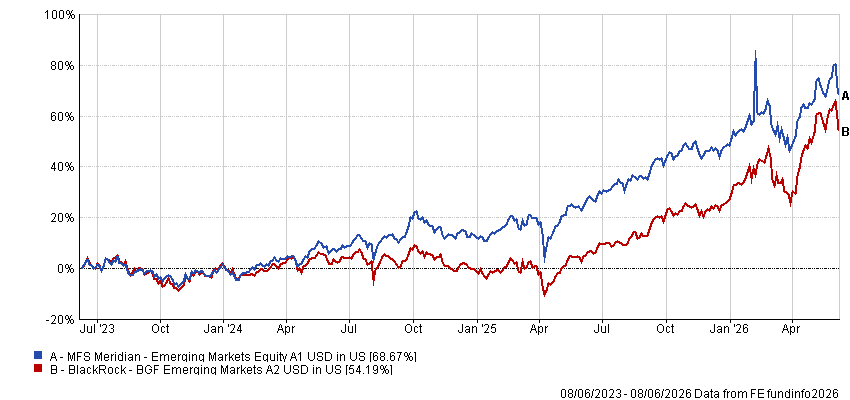
Given their different investment styles, the two strategies are expected to perform differently depending on market conditions, according to Ting.
She believes that the MFS strategy is likely to perform better in environments where quality and earnings resilience are rewarded, such as during periods of heightened volatility or down markets.
“Its preference for cash-generative companies with appropriate leverage and strong corporate governance has historically supported more resilient returns and some downside protection, as seen during past emerging markets downturns in 2015, 2018 and 2022,” Ting said.
In contrast, the BlackRock strategy exhibits a less predictable performance pattern due to its flexible approach.
“While performance has been solid over the short period since Egon Varek took over as manager in April 2025, the strategy’s flexible mandate and recent shift toward a more bottom-up, stock-specific approach warrant a longer performance history across varied market environments to draw more robust conclusions,” said Ting.
Ting also thinks the BlackRock strategy is more likely to be volatile due to its flexible approach. “In contrast, the MFS strategy’s focus on quality companies should help dampen volatility and provide some downside resilience in down markets,” she said.
Indeed, the BlackRock strategy has historically exhibited a higher standard deviation than the MFS strategy as well as the global emerging markets equity Morningstar category and the MSCI Emerging Markets Index over the 1-, 3-, 5-, 10-year periods ending 31 March 2026, although the long-term track record was built by a different portfolio manager.
“There is a clear difference between the two strategies in terms of team stability and support,” Ting said.
“The MFS strategy benefits from a more established and stable management team, with Rajesh Nair and Lionel Gomez both long-tenured investors at the firm who have worked closely together for many years, and with complementary expertise,” she said.
Nair has co-managed the strategy since August 2021, while Gomez joined as co-manager on 1 May 2025. While this strategy has also undergone several manager transitions, these have been orderly and well-planned, reflecting MFS’ disciplined succession approach, according to Ting.
“This stability is reinforced by a well-resourced analyst platform, with 19 dedicated emerging-markets analysts who are experienced and deeply embedded in the process.”
In contrast, the BlackRock strategy has seen “ongoing team turnover”. The strategy has a relatively new lead manager, Egon Vavrek, who took over in April 2025.
“While he is experienced, he does not have a public long-term track record, so more time is needed to see him in action to gauge his capability,” Ting said.
The broader team has undergone significant restructuring, with resources reduced materially to 13 analysts, and turnover remains elevated. “This has led to concerns around research depth, coverage continuity, and quality, particularly as the strategy becomes more reliant on bottom-up stock selection,” said Ting.
Although both managers are experienced, Ting’s conviction in the BlackRock strategy’s new lead manager is still developing. Meanwhile, the MFS strategy benefits from “greater team stability, depth of resources, and continuity”, she said.
The BlackRock Global Funds – Emerging Markets fund A2 (LU0047713382) has an ongoing charge of 1.87%, and the MFS Meridian Funds – Emerging Markets Equity fund A1 USD (LU0219444832) has an ongoing charge of 2.00%.
The two funds fall within the most expensive quintile of the global emerging markets equity Morningstar category, noted Ting. According to Morningstar studies, fees are the best predictor of a fund’s future success, and an investor should select the cheaper fund, all else being equal.
Both strategies earn a Morningstar medalist rating of neutral. However, Ting has a stronger conviction in the MFS strategy, as reflected in its Above Average People and Process pillar ratings. Meanwhile, the BlackRock strategy has Average People and Process pillar ratings.
“We favour the MFS strategy for its capable and experienced portfolio managers, and also its well-resourced and stable supporting team,” Ting said.
“However, investors should be aware that both strategies can sport high volatility given their focus on a developing asset class. As such, the two strategies would be more suitable for investors with a long investment horizon who are willing to weather short-term headwinds,” she concluded.
This week FSA compares the BlackRock Global Funds – Emerging Markets fund and the MFS Meridian Funds – Emerging Markets Equity fund.
Asian investment grade credit is better prepared for the energy fallout than in previous years, according to Nomura Asset Management’s head of fixed income, Simon Tan.
The acquisition should expand the asset manager’s European private markets capabilities.